
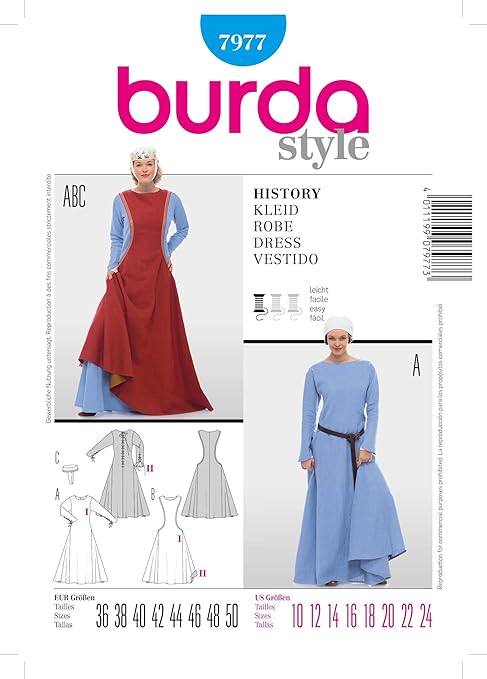
One of the easiest patterns I have ever worked with recently was the Burda 7977 pattern for a medieval style kirtle and sideless surcote. I sometimes have an impulse where I just absolutely have to make something and this was one of those patterns. I ended up wearing it to a medieval faire in Germany and was surprised by how absolutely comfortable and warm I was!
The pattern itself looks like this:
Unfortunately I do not have any photos of the making of this dress as it took place several months before I even started thinking about making a blog. That being said, I can still at least offer my thoughts on the pattern and some photos of the completed outfit.
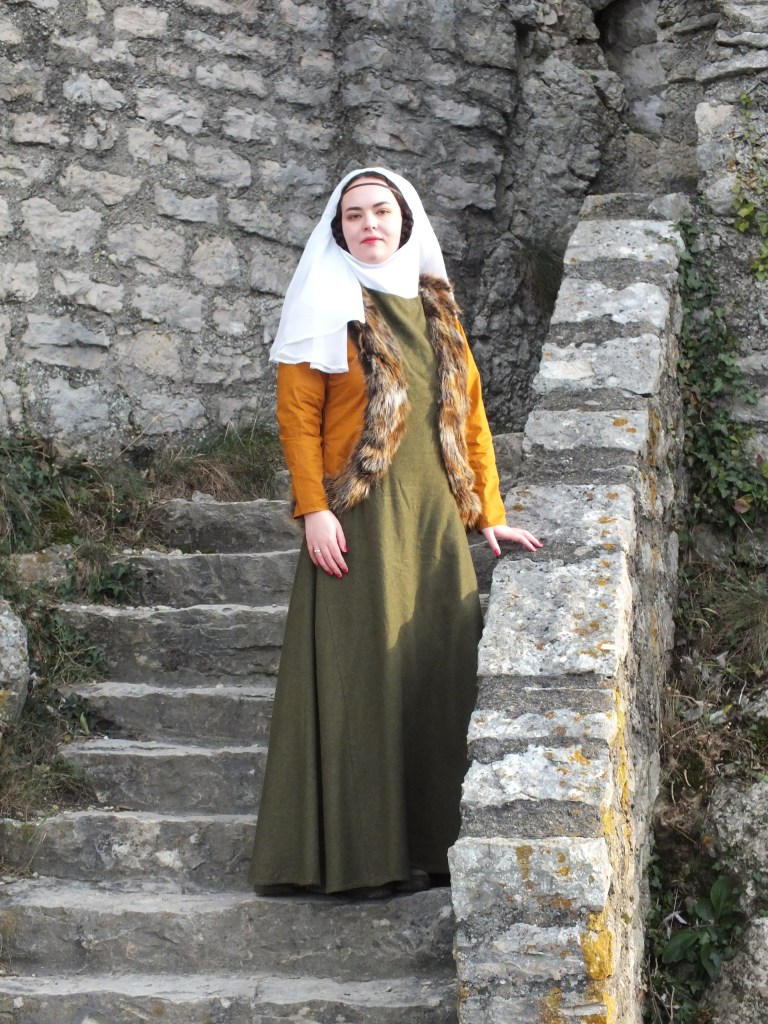
The kirtle is rather simple with a front and back piece with two side gores cut on the fold. The neckline is clean finished by a facing. The sleeves come in two pieces: the oversleeve and undersleeve. The oversleeve is designed to lace closed over the undersleeve. Both are technically cut out from the same fabric but the undersleeve could be cut from a white linen to imitate the look of a shift if you’re not wearing one. Additionally the lacing could be done away with and replaced with buttons instead which I believe is the more historically accurate method of doing so. I, being lazy, just opted for simplicity so I used only the undersleeve pattern in the making of my kirtle. The back of the kirtle has a facing attached to it as well and is closed with eyelets.
The surcote is made of similar pattern pieces and the neckline is also clean finished with a facing. The pattern suggests to finish the sideless portions by folding the edges towards the outside and covering with trim. I opted for some faux fur instead as that is what I saw in many reference pictures. Adding it was just a matter of measuring the circumference of the “armholes”, choosing the width I wanted, and then adding in the seam allowances.
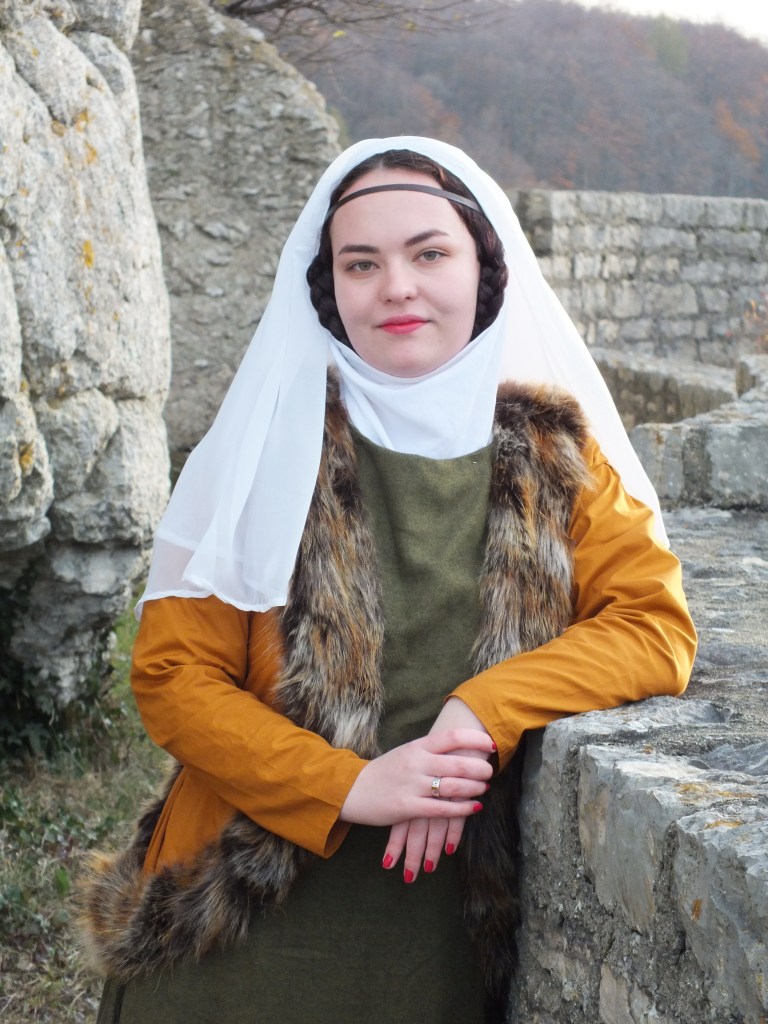
For my head coverings I first started out with a St. Birgitta’s cap. The tutorial can be found here: http://geekyyarn.blogspot.com/2013/11/cap-of-st-birgitta-tutorial.html
Following that I used a rectangular strip of linen I had laying around and hemmed it and used that as my wimple. The wimple gets pinned to the cap. For the veil I used a meter of white organza, cut it into a large circle about 150cm in diameter. For this time period a veil should only come to about shoulder length. I folded it in half because I liked how the fabric draped and then pinned that onto the cap/wimple.
The hair was simply just combing it out, parting it down the middle, and then braiding both sections down over the ears. Once the braids were done I let a portion hang to about chin length and then looped the rest behind my ears and secured the ends to the back of my head with pins. I recommend using some sort of hair product in the way of cream, gel, or pomade to keep the braids looking smooth and prevent any flyaways.
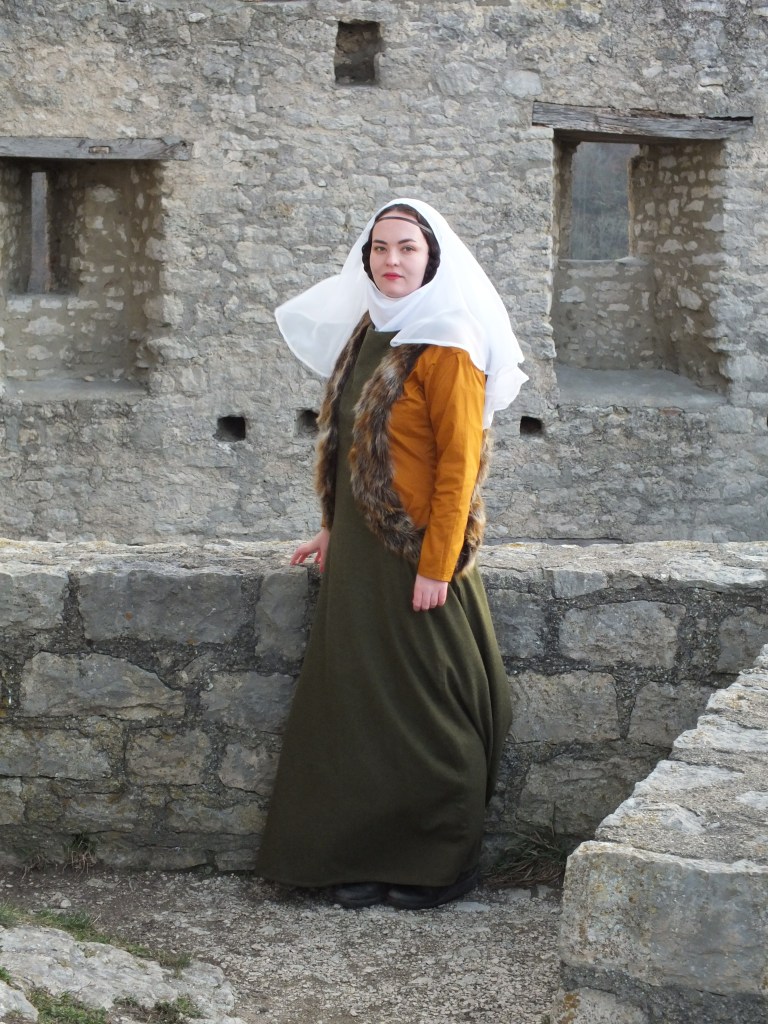
This is a pattern I would absolutely recommend. In fact I will be helping my mom learn to sew with it. The instructions are easy to follow and the dress can be made very quickly. Numerous modifications can be made to it to suit your needs. Most importantly it’s just incredibly comfortable. That’s my favorite thing about it.
If you’ve made this dress too let me know how it came out!
 The Sewing Queen